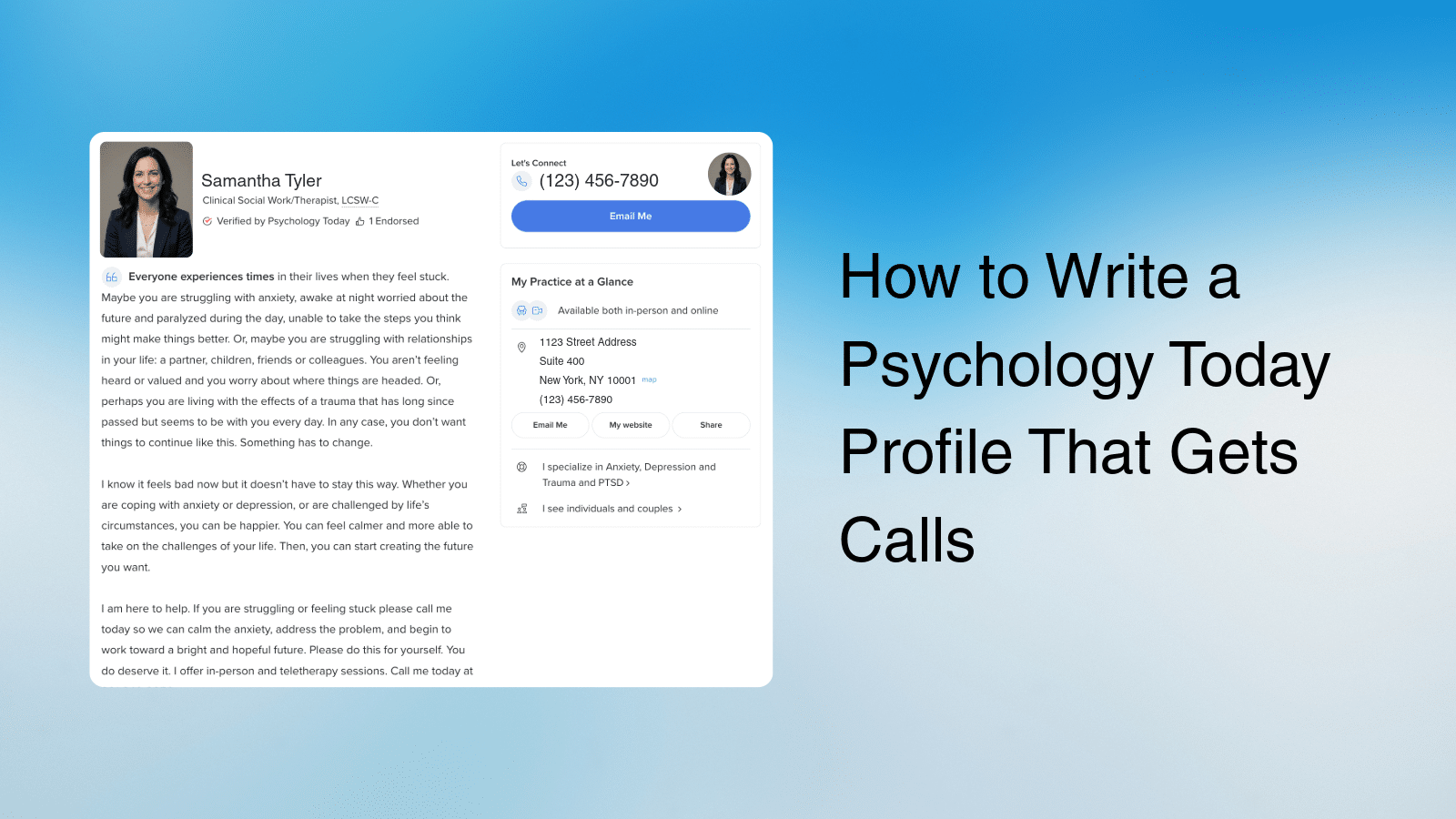
Most advice on writing a Psychology Today profile is a list of tips with no acknowledgement of the argument going on around it, which is whether the directory still delivers what it used to.
Start there, because it determines how much any of the advice below is worth.
The argument about referrals
Since roughly 2023, therapists have been reporting steep drops in directory inquiries. ClearHealthCosts covered this in December 2025 and again in January 2026. One licensed clinical social worker, interviewed directly, described a 50 percent decrease in referrals after years of never being without a waitlist. One marriage and family therapist’s contact numbers ran 357 in 2021, 161 in 2022, 72 in 2023, 85 in 2024 and 40 in 2025. Other accounts in the same reporting are quoted from therapist forums rather than interviews, including one describing a move from the first page or two of results to page six or seven.
It is not universal. The same reporting notes that some therapists say they have seen no difference at all.
Psychology Today disputes that anything system-wide has changed. Its position is that overall traffic to the site and total contacts to therapists have remained strong, that there has been no overall decline in directory visits and no material change in total contacts, and that individual fluctuations occur but do not reflect a system-wide shift. Separately, it says it periodically updates its algorithms to improve the consumer experience and provide more balanced choice, rather than concentrating traffic in one direction. It has also said the price has not changed since 2004 and that everyone pays the same, with no preferential placement.
Those last two statements sit slightly awkwardly together, and it is worth being clear that any reconciliation is inference rather than something the company has confirmed. One reading is that total contacts can hold steady while being spread across more profiles, in which case a therapist who previously did well would see their own share fall without the overall number moving. Psychology Today has not said that is what happened and explicitly rejects the system-wide framing.
The practical conclusion is the same either way. You have no visibility into how results are ordered and no lever that reliably moves your placement. What you can still control is whether someone who is already looking at your profile decides to contact you. That is where the effort belongs.
The opening lines carry the whole thing
Someone scanning a results page reads your photo and the first sentence or two of your personal statement. That is the decision. Everything else on the profile is confirmation for people who have already half-decided.
The most common failure is opening with yourself. Credentials, years in practice, a training lineage. It is accurate, and it is the least useful thing you could put in the space where someone decides whether you understand them.
Write the opening for one specific person instead. Not a demographic, a situation. The parent who has not slept properly since the diagnosis. The high performer whose anxiety only shows up at 3am. The couple who have had the same argument for six years. Someone in that situation reads it and recognises themselves, and recognition is what makes people pick up the phone.
This feels counterintuitive because it seems to narrow your market. It does the opposite. A profile written for everyone is recognised by nobody, and it competes against every other general profile in your city on price and proximity alone.
The photo, and the video
Warm and professional, looking at the camera, face clearly visible, recent. It does not need to be expensive. A well-lit photo taken properly on a phone outperforms a dated studio headshot where you look like you would rather be elsewhere.
What to avoid: sunglasses, a group shot, heavy filtering, and anything so formal it reads as unapproachable. Someone deciding whether to tell you the worst thing that has happened to them is making a judgment about warmth in about a second.
On video, Psychology Today’s own stated position is that profiles which are complete, client-focused, transparent and professionally presented, including strong photos and video, tend to perform well. That is the company linking video to performance, so if you are comfortable on camera it is worth doing. What nobody can tell you is whether the benefit is in placement, in conversion, or both.
Specialties, and the trap of selecting everything
The instinct is to tick every box you are competent in, on the theory that more boxes means more searches you appear in. Mechanically that is true, and it is still usually the wrong move.
Someone searching for a trauma specialist and finding a profile listing thirty-one specialties concludes you are a generalist. The person who lists four and writes about them with obvious depth reads as the specialist. You will appear in fewer searches and be contacted from more of them.
Pick the ones you actually want more of. If you are tired of a presentation, do not list it.
Insurance, fee and availability
Fill these in properly. They are the fields people filter on before they read a word you wrote, and an incomplete one removes you from the results rather than making you look flexible.
Keep the plans list current. A prospective client who contacts you on the strength of a plan you dropped eight months ago is a wasted conversation for both of you, and it is the sort of thing that generates a bad review.
Answer quickly
The common recommendation, including from clinicians writing on this for the platforms, is to reply within 24 hours or less. Same day is better where you can manage it.
The reasoning is straightforward: someone who has finally worked themselves up to asking for help loses momentum quickly, and directory inquiries are easy to send to more than one therapist. If you cannot reliably answer that fast yourself, that is an argument for changing how inquiries reach you rather than for trying harder.
The tricks that circulate, and what to make of them
Therapist forums carry a steady supply of placement theories. Change your zip code to a busier one. Edit the profile weekly to look active. Adjust how your name is entered.
Be sceptical of all of it. Psychology Today does not publish how results are ordered, which means every theory in circulation is inference from one person’s experience. The widely repeated claim that placement is randomised or rotates is asserted in a lot of places and sourced in none of them, so treat it as an unverified hypothesis rather than a finding, however well it fits what people describe.
The zip code question deserves a straight answer, because it is the one with consequences: listing an address you do not practise from misrepresents your location to prospective clients, and it is not worth the risk to your listing or your license for an effect nobody has demonstrated.
Common questions
How much does a Psychology Today profile cost?
The standard directory membership is $29.95 a month in the US. It runs month to month with no contract, so it can be cancelled at any time. Psychology Today has said the price has been unchanged since 2004 and that everyone pays the same rate, with no preferential deals.
How do I boost my Psychology Today profile?
There is no paid boost or promoted placement, and Psychology Today does not publish how results are ordered. What you can control is whether someone who sees your profile contacts you: the first two sentences, the photo, a focused list of specialties, accurate insurance and fee fields, and how fast you reply. The company has also said that complete, client-focused profiles with strong photos and video tend to perform well.
Why did my Psychology Today referrals drop?
Therapists have reported declines since roughly 2023, though not universally, and some report no change. Psychology Today says overall traffic and total contacts have held steady and that individual fluctuations do not reflect a system-wide shift. It has separately said it periodically updates its algorithms to provide more balanced choice rather than concentrating traffic in one direction. Nobody outside the company can say which of those explains an individual drop.
How many specialties should I list?
Fewer than you are qualified for. A profile listing thirty specialties reads as a generalist; one listing four with real depth reads as a specialist. You will show up in fewer searches and convert more of them. List the work you want more of, not everything you can do.
Does changing my zip code improve placement?
Nobody has demonstrated that it does, and listing an address you do not practise from misrepresents your location to prospective clients. It is not a risk worth taking for an unproven effect.
How quickly should I respond to inquiries?
The common recommendation is within 24 hours or less, and same day where you can. Someone who has finally worked up to asking for help loses momentum quickly, and a directory inquiry is easy to send to more than one therapist.
The structural problem with the whole exercise
Do all of the above and you will have a better profile, and a better profile is worth having. But it is worth being clear about what you have built.
You have improved an asset you do not own, on a platform that can reorder its results without telling you, alongside every other therapist in your area doing the same thing. Whatever the explanation for the last two years of reports, the therapists describing them could not see the cause, could not verify it, and could not appeal it. That is the structural position, and it does not change with a better opening paragraph.
Which is an argument for the profile being one channel among several rather than the channel. A directory sends people who are choosing between you and everyone else on the page. Your own site, ranking for the specific thing you treat in the place you practise, sends people who were looking for what you do. Those are different conversations, the second converts better, and nobody else can reorder it.
If you are weighing up whether the listing still earns its place, we wrote separately about how to cancel a Psychology Today profile and whether you should, including the pause option most therapists do not know exists, and about how the main directories compare. If the question is what should be sending you clients instead, that is what we do for therapists and private practices, and the audit is free.
Sources
Pricing and membership terms from Psychology Today’s membership signup. Therapist reports and Psychology Today’s responses from ClearHealthCosts, December 2025 and January 2026, which is also the source for the pricing and placement statements. Response-time guidance from Headway’s profile guidance. Last reviewed August 2026.